

IELTS Speaking Part 2: Master the One-Minute Planning Method
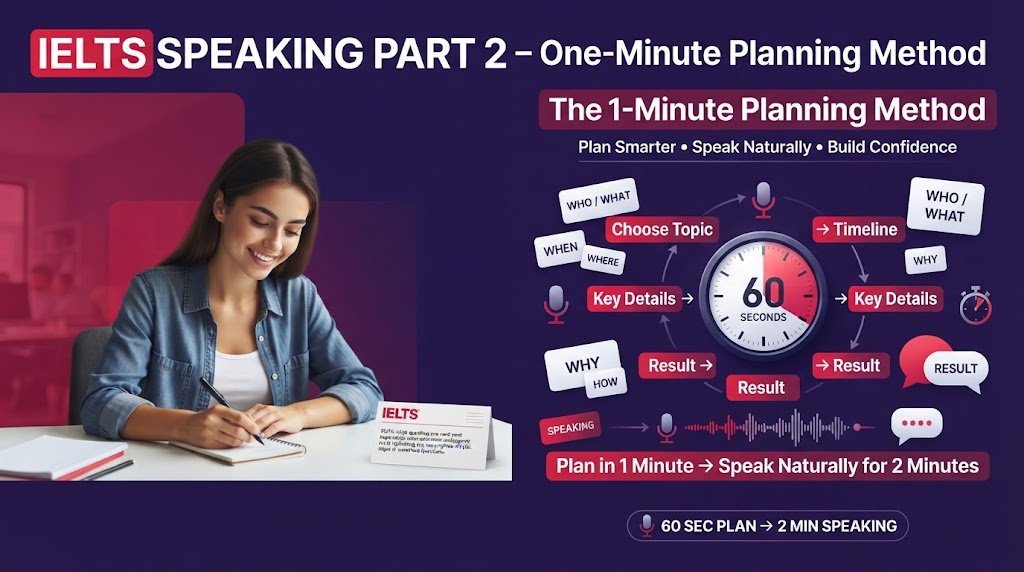
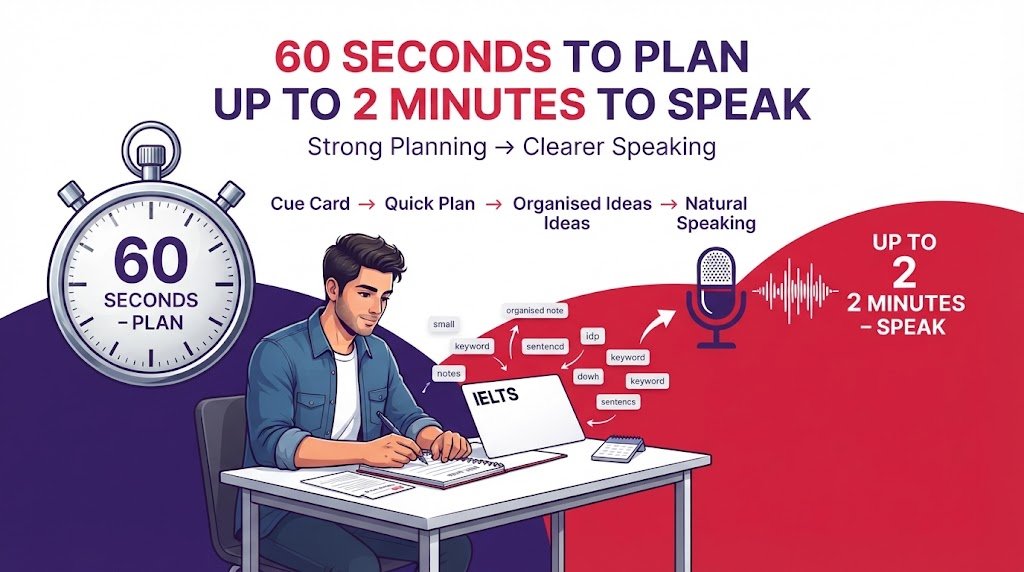
IELTS Speaking Part 2 can feel challenging because you have very little time to prepare before you begin speaking. You receive a cue card, have only one minute to prepare, and are then expected to speak continuously for up to two minutes.
For many candidates, the biggest difficulty is not a lack of English vocabulary. The real problem is that they do not know how to organise their ideas quickly.
A strong plan can lead to stronger speaking. When your plan is clear, you know what to say next, your ideas follow a logical sequence, and it becomes much easier to continue speaking naturally. A weak plan, on the other hand, can leave you searching for ideas, repeating yourself or finishing your answer too early.
The solution is to learn a simple and repeatable one-minute planning method.
Why Planning Matters in IELTS Speaking Part 2
The preparation time in Speaking Part 2 is extremely short. You do not have five or ten minutes to construct an answer. You have approximately 60 seconds.
This means you must use your preparation time intelligently.
The purpose of the one-minute preparation period is not to write your complete answer. There is simply not enough time. Instead, your goal should be to create a quick mental map of your response.
Your notes should help you answer questions such as:
- What am I going to talk about?
- When and where did it happen?
- Why was it important?
- What happened next?
- What details can I add?
- How did I feel?
- What was the final result?
Once these ideas are clear, your notes become a roadmap that can guide you through your two-minute response.
Use Keywords, Not Complete Sentences
One of the most important rules of IELTS Speaking Part 2 planning is:
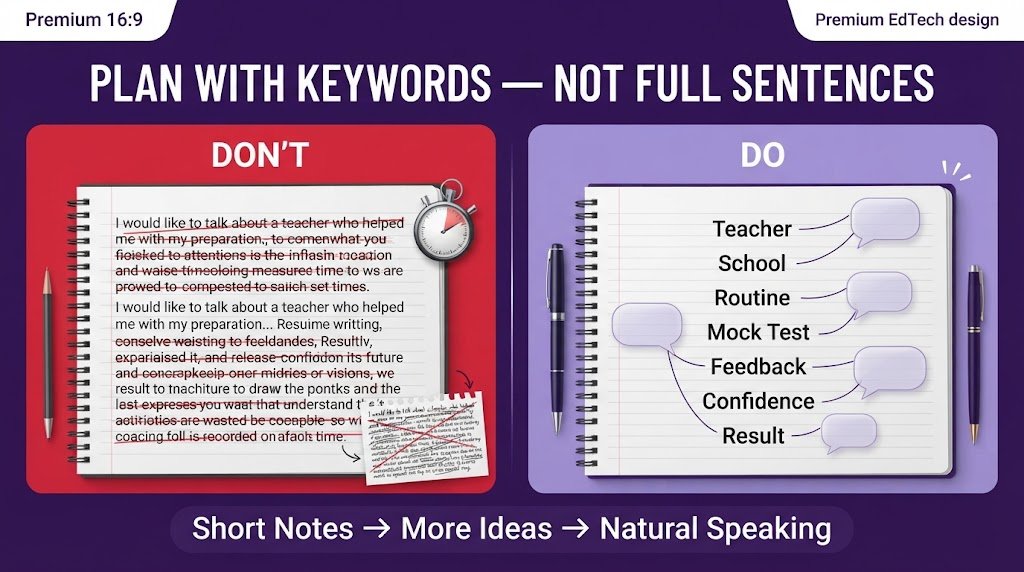
Do not waste your preparation time writing complete sentences.
Imagine that your cue card asks you to describe a teacher who helped you. You could spend valuable time writing:
“I would like to talk about my teacher who helped me with my preparation.”
That sentence takes time to write but gives you very little useful planning information.
Instead, you could write:
teacher – school – routine – mock – feedback – confidence – result
These short keywords are much more useful.
Each word can trigger several sentences while you are speaking. For example, “feedback” might remind you to explain what feedback the teacher gave you, what mistakes were identified and how you improved.
Short notes are easy to write, easy to remember and easy to expand.
Your plan should therefore contain ideas rather than sentences.
A Practical Cue Card Example
Consider this cue-card topic:
Describe a goal that you achieved.
You may need to explain:
- what the goal was;
- when you set the goal;
- when you achieved it; and
- how you felt after achieving it.
This is an excellent topic for practising the one-minute planning technique because a successful answer needs several elements: a clear timeline, actions, supporting details, emotions and a final result.
Instead of trying to write an answer during your preparation time, create a structured set of prompts.
For example:
English speaking goal – last year – home/academy – study abroad – daily practice – mock tests – trainer feedback – pronunciation – nervous → confident – higher score
These notes provide enough material to build a much longer spoken response.
The Who–What–When–Where–Why–How Formula
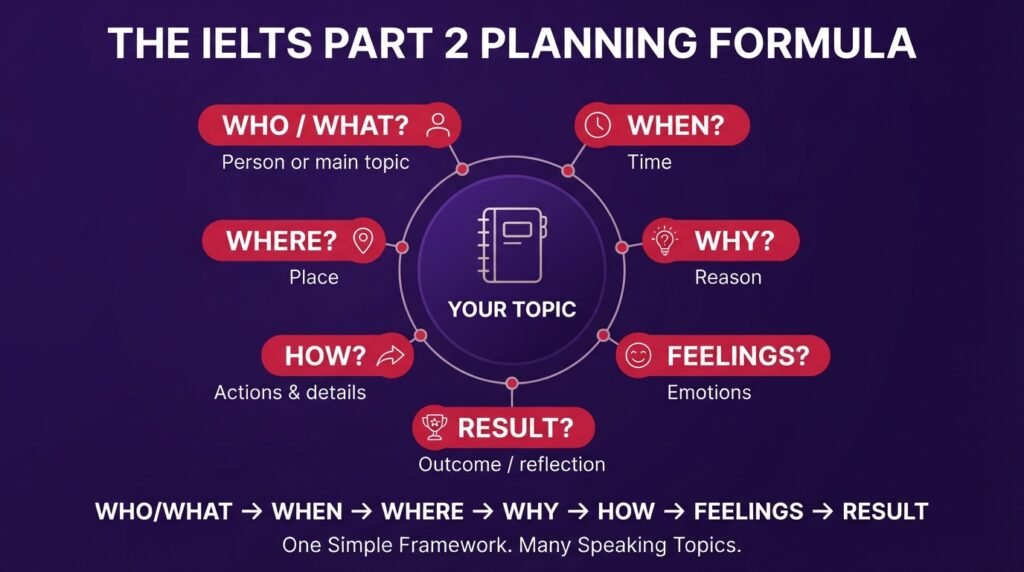
A simple formula can help you generate ideas for almost any IELTS Speaking Part 2 topic:
Who – What – When – Where – Why – How – Result
These familiar question words give your answer structure.
Using the goal example, your plan might look like this:
What? Improve my English speaking.
When? Last year.
Where? At home and at an academy.
Why? Study abroad and professional development.
How? Daily practice, recorded answers, mock tests and trainer feedback.
Feelings? Nervous initially, increasingly confident later.
Result? Better fluency, stronger communication and a higher score.
Notice that this is still not a complete answer.
It is a speaking map.
When you begin talking, each keyword reminds you of an idea that you can explain naturally.
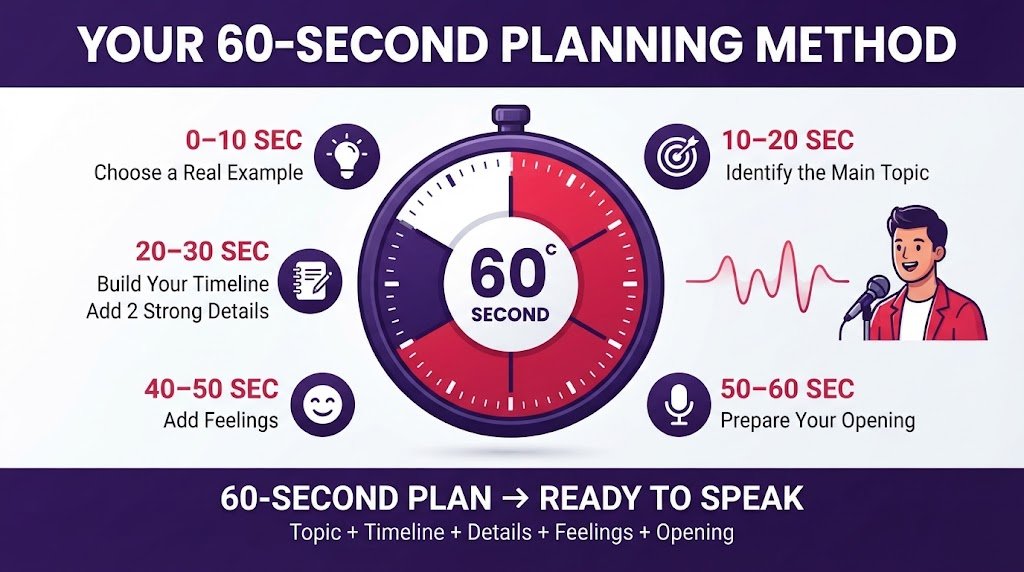
The 60-Second Planning Method
A useful way to control your preparation time is to divide the minute into six short stages.
First 10 Seconds: Choose a Real Example
Do not waste time searching for the “perfect” story.
Choose something familiar.
Real or familiar experiences are generally easier to describe because you already know the details. You do not need to invent people, places, emotions or events while speaking.
If the topic is about achieving a goal, for example, you might choose improving your English, completing a qualification, getting a job, learning to drive or achieving a fitness goal.
The important thing is to choose quickly.
Next 10 Seconds: Identify the Main Topic
Write down the central idea of your story.
For example:
English speaking goal
This keeps your response focused.
Next 10 Seconds: Create a Timeline
Now establish the sequence of events.
For example:
before test → daily routine → mock speaking → final test/result
A timeline is particularly useful because it gives you a natural order in which to speak.
Next 10 Seconds: Add Two Strong Details
Add specific details that will allow you to develop the story.
For example:
recorded answers – pronunciation correction
Specific details make your response easier to expand and more interesting to listen to.
Next 10 Seconds: Add Feelings
Do not forget emotions.
For example:
nervous → motivated → confident → proud
Feelings make an answer more personal and help you explain why an experience mattered to you.
Final 10 Seconds: Prepare Your Opening
Use the final few seconds to prepare your first sentence.
For example:
“I’d like to talk about my goal of improving my English speaking skills.”
You do not need to write the entire sentence. Simply knowing how you will begin can make it easier to start confidently.
By the end of the minute, you should have a topic, timeline, details, feelings, result and opening.
You are now ready to speak.
Weak, Better and Stronger Planning
The quality of your planning can significantly affect how well you develop your answer.
Consider three different plans for the same goal topic.
A Weak Plan
goal – study – good result – happy
The problem is not that these ideas are wrong. The problem is that they are too broad.
There is no clear timeline, little supporting detail and almost no development. A candidate using these notes may quickly run out of things to say.
A Better Plan
goal – last year – daily practice – mock test – good score
This is an improvement.
There is a topic and a basic sequence. However, the story could still benefit from greater detail and personal development.
A Stronger Plan
English speaking goal – work/study pressure – daily recording – trainer feedback – pronunciation correction – nervous → confident – better communication
This plan provides much more support.
It includes background, action, specific details, emotions and a result. These prompts can help the candidate develop a fuller and more natural response.
The lesson is simple: good planning does not mean writing more. It means choosing better keywords.
Useful Planning Phrases
You can train yourself to use short planning prompts such as:
main goal – last year – at first – main problem – daily effort – useful feedback – small progress – final result – felt proud – changed mindset
These phrases are short enough to write quickly but meaningful enough to remind you what to discuss.
With practice, you should be able to look at a few keywords and immediately expand them into complete spoken ideas.
Grammar and Tense Control
Planning is not only about content. A clear timeline can also help you control your grammar.
If you are describing a completed experience, you will often need the past simple:
“I achieved this goal last year.”
“I practised every evening.”
You may also use the past continuous to provide background:
“I was working full-time at the time.”
“I was feeling quite nervous before the test.”
When discussing the continuing impact of an experience, the present perfect can be useful:
“This experience has improved my confidence.”
Your notes can therefore remind you not only what happened, but also when it happened.
Simple linking expressions can also make the sequence clearer:
At first…
After that…
Because of this…
In the end…
Looking back…
These expressions help connect different stages of your story.
Common IELTS Speaking Part 2 Planning Mistakes
Several common mistakes can reduce the effectiveness of your one-minute preparation.
Mistake 1: Writing Full Sentences
Complete sentences consume too much preparation time.
Write keywords and short phrases instead.
Mistake 2: Planning in Your First Language and Translating
Some learners write their notes in Urdu or another first language and then translate them mentally while speaking.
This can create unnecessary pauses.
Where possible, train yourself to create simple planning notes directly in English.
Mistake 3: Creating an Unrealistic Story
A complicated invented story can become difficult to continue because you have to create new details while speaking.
Choose a familiar or believable example that you can discuss comfortably.
Mistake 4: Forgetting Feelings
Do not describe only what happened.
Include how you felt.
Useful words might include:
nervous, excited, motivated, relieved, confident, satisfied, surprised, proud
Emotions can give your answer greater depth.
Mistake 5: Having No Final Result
Your story should go somewhere.
Explain what changed, what you achieved or what you learned from the experience.
Mistake 6: Starting Without Knowing Your Opening
The first few seconds of your response are important.
Preparing a simple opening during your planning time can help you begin smoothly rather than hesitating.
Practice the Method with Different Cue Cards
The planning system should work across many different topics.
Try these examples.
Topic 1: Describe a skill you learned
Plan:
skill – time – place – problem – practice – result
Topic 2: Describe a person who helped you
Plan:
person – situation – advice – support – feelings – result
Topic 3: Describe an important decision you made
Plan:
decision – reason – difficulty – action – result – lesson
Give yourself exactly 60 seconds to plan each topic.
Then speak for up to two minutes.
Do not write a complete answer beforehand.
The purpose of the exercise is to train your brain to turn short prompts into natural spoken English.
Memorise the System, Not Cue-Card Answers
One of the most useful principles for IELTS Speaking preparation is:
Do not memorise dozens of complete cue-card answers. Learn a planning system that you can apply to different topics.
The exact topic you receive may be about a person, place, achievement, skill, experience, problem, decision, object or event.
A flexible planning framework can be adapted quickly:
Who/What → When → Where → Why → How → Details → Feelings → Result
When you understand this structure, you are not dependent on receiving a familiar question.
You have a method for generating an answer.
Homework: Five Cue Cards
Choose five IELTS Speaking Part 2 cue cards and give yourself exactly one minute to prepare each one.
For every card, check:
Did I choose one clear example?
Did I identify who or what I am discussing?
Did I include when and where?
Did I explain why it happened or why it mattered?
Did I include at least two strong details?
Did I include feelings?
Did I finish with a result, lesson or reflection?
After planning, speak for up to two minutes and record yourself.
Listen to the recording and evaluate your performance.
Check your fluency. Check whether your tenses remained consistent. Listen to your pronunciation. Notice unnecessary pauses or repetition. Most importantly, ask yourself:
Did my plan help me continue speaking naturally?
Repeat the activity regularly and compare your newer recordings with your earlier attempts.
Final Takeaway
Strong IELTS Speaking Part 2 performance begins before you say your first sentence.
The one-minute preparation period gives you an opportunity to organise your thoughts, establish a timeline and create a clear direction for your response.
Do not try to write everything you want to say.
Instead, create a compact speaking map:
Choose a familiar example → identify the main idea → create a timeline → add details → include feelings → prepare an opening → finish with a result.
Your keywords are not your answer. They are prompts that help you build your answer naturally.
The more you practise this system, the faster you can organise unfamiliar topics and turn a simple cue card into a structured two-minute response.
The next stage is learning how to transform this one-minute plan into a complete story using a stronger Speaking Part 2 structure: opening, background, main details, challenge, feelings, result and reflection.

Leave a Reply